







Latest version of Angular, feature updates and Technology comparison
March 20, 2026
Introduction to Angular
Angular is a popular TypeScript-based front-end framework developed by Google for building modern web applications. It follows a component-based architecture and provides built-in tools such as routing, dependency injection, form handling, HTTP services, and testing.
Because Angular offers a complete development framework, it is widely used for enterprise applications, dashboards, SaaS platforms, and large-scale web systems.
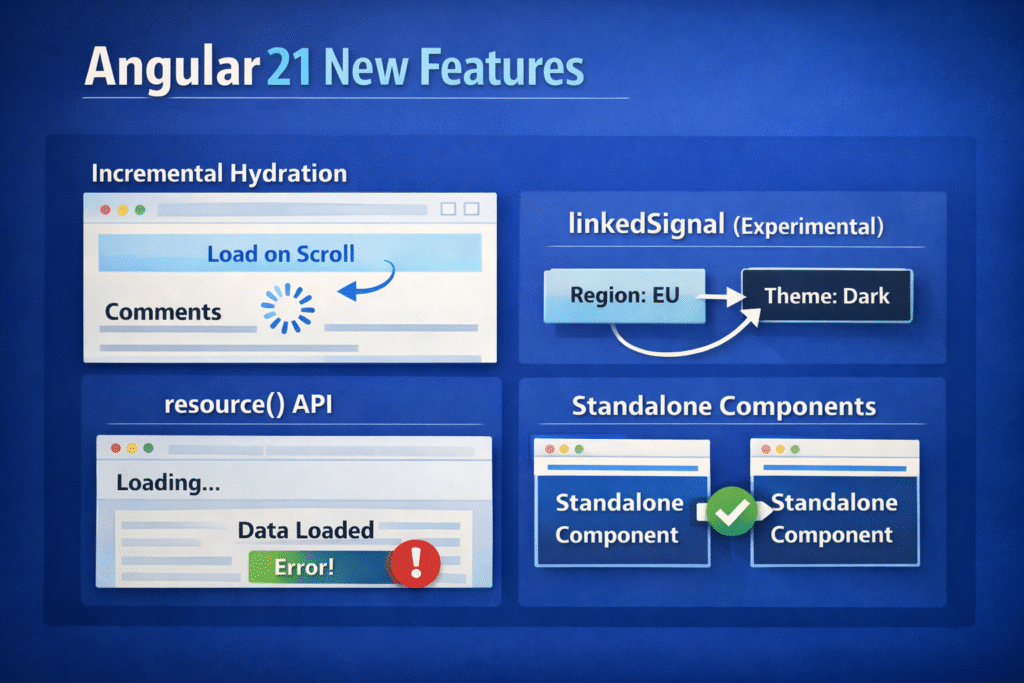
Overview of the Latest Angular Version (Angular v21)
The latest major release, Angular v21, launched in November 2025. This version focuses on:
– Improved performance
– Modern reactive programming
– Better developer experience
– Accessibility improvements
– Integration with modern tooling
Angular v21 continues the framework’s shift toward signal-based reactivity and simplified architecture.
Key Feature Updates and Improvements
1. Zoneless Change Detection
Angular v21 introduces zoneless change detection, reducing reliance on Zone.js.
Benefits:
– Faster performance
– Smaller bundle sizes
– More predictable UI updates
– Easier debugging
2. Signal Forms
Angular now introduces Signal Forms, which use Angular Signals to manage form state.
Advantages:
– Simpler form logic
– Reactive state management
– Better performance compared to traditional reactive forms
3. Angular Aria (Accessibility Components)
Angular v21 adds Angular Aria, a library for building accessible UI components.
It provides components such as:
– Tabs
– Menus
– Accordions
– Toolbars
– Comboboxes
These components follow accessibility standards and ARIA guidelines.
4. Faster Testing with Vitest
Angular now supports Vitest as the default testing tool.
Benefits include:
– Faster test execution
– Better TypeScript support
– Improved developer experience
5. Built-in HTTP Client Setup
Angular v21 simplifies API integration by including HttpClient by default in new projects, reducing configuration steps.
6. AI-Assisted Development Support
Angular v21 supports AI-powered development tools using the Model Context Protocol (MCP).
This allows AI tools to better understand Angular applications and provide smarter code suggestions.
Benefits of Using Angular v21
Using the latest Angular version provides several advantages:
– Better performance through zoneless architecture
– Modern reactive state management with Signals
– Improved accessibility tools
– Faster testing and development workflow
– Simplified configuration and architecture
These improvements make Angular more efficient for modern web application development.
Angular vs React vs Vue
Angular is often compared with two other popular front-end technologies.
Angular
Angular is a full-featured framework with built-in tools for routing, forms, dependency injection, and testing.
– Full Framework
– Signals (Fine-grained)
– Moderate to Steep
– Two-way & One-way
– Everything Included
It is commonly used for large and enterprise-level applications.
React
React is a UI library developed by Meta Platforms. It focuses mainly on building user interface components.
React usually requires additional libraries for routing, state management, and form handling.
– Library (Unopinionated)
– Virtual DOM & Hooks
– Moderate
– One-way
– Requires 3rd Party Libs
Vue
Vue.js is known for its simplicity and easy learning curve. It is commonly used for small to medium applications and quick development projects.
– Progressive Framework
– Signals/Composition API
– Gentle
– Two-way & One-way
– Optional Official Libs
When to Choose Angular Over Other Frameworks
Angular is not always the best choice for every project. However, it is particularly strong in certain scenarios.
Large Enterprise Applications
– Angular applications are easier to maintain and scale over time because of their consistent architecture.
Long-Term Projects
– Angular applications are easier to maintain and scale over time because of their consistent architecture.
Complex Business Logic
– Applications with many modules, dashboards, and workflows benefit from Angular’s built-in tools.
TypeScript-Focused Development
– Angular is built around TypeScript, making it a strong choice for teams that prefer strongly typed development.
Integrated Tooling
– Angular includes many features out of the box, reducing the need for third-party libraries.
Conclusion
Angular continues to evolve as one of the most powerful frameworks for building modern web applications. The release of Angular 21 introduces major improvements such as zoneless change detection, signal-based forms, accessibility-focused components, faster testing with Vitest, and AI-assisted development tools.
While other technologies like React and Vue remain popular for their flexibility and simplicity, Angular stands out as a structured, scalable framework designed for large and complex applications.
For organizations building enterprise platforms, SaaS products, and large dashboards, Angular remains one of the most reliable choices in the modern web development ecosystem.
Get In Touch
"Share your ideas and get the best software service in the industry."

No comment