







Domains/Industries Where Angular Is Commonly Used
April 16, 2026
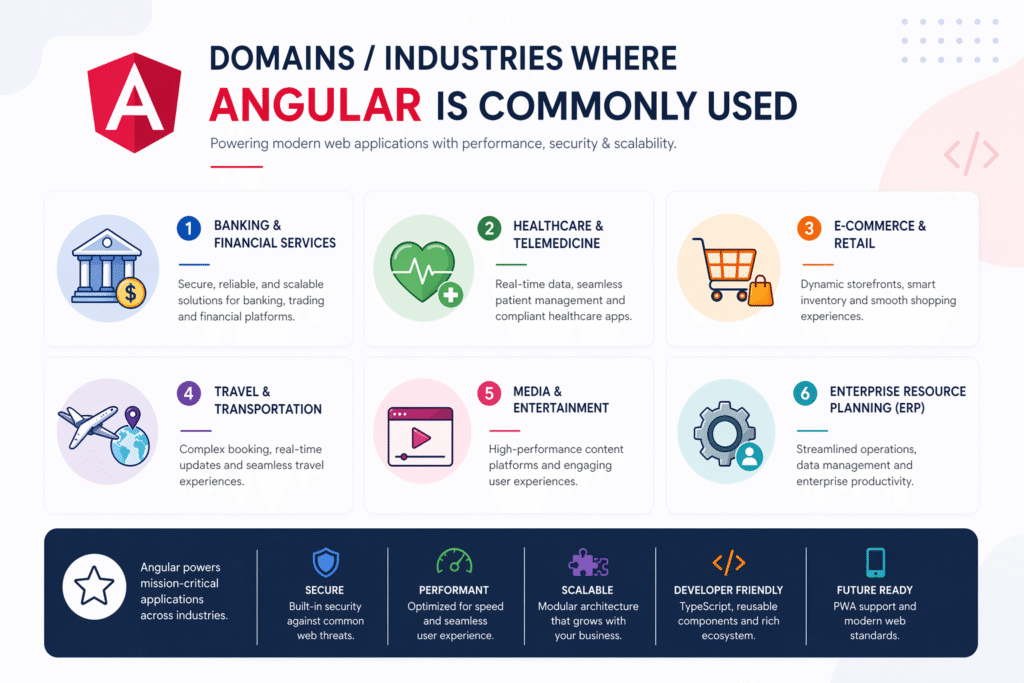
1. Banking and Financial Services (FinTech)
FinTech is arguably the primary domain for Angular. Financial institutions require extreme security, high performance, and the ability to handle complex mathematical operations on the client side.
- Why Angular fits: * Security: Angular has built-in protections against common web vulnerabilities like Cross-Site Scripting (XSS).
- Data Integrity: Its strong typing (via TypeScript) ensures that complex financial data structures remain consistent.
- Modular Architecture: Banks often have massive teams; Angular’s structure allows different teams to work on different modules (loans, savings, credit cards) simultaneously.
- Practical Example: Online banking portals, stock trading platforms, and insurance management systems.
Real-World Case: PayPal uses Angular for several of its checkout flows and internal dashboards to ensure seamless transaction handling.
2. Healthcare and Telemedicine
Healthcare applications deal with massive amounts of patient data, imaging, and real-time scheduling.
- Why Angular fits:
- RxJS (Observables): Angular’s integration with RxJS makes it easy to handle real-time data streams, such as live patient monitoring or instant lab results.
- SPA Performance: Single Page Applications (SPAs) allow doctors to navigate through patient records without the lag of page reloads, which is critical in emergency settings.
- Practical Example: Electronic Health Record (EHR) systems, hospital management software, and patient portals.
Real-World Case: Forbes reported that various internal healthcare management tools for large-scale providers are built on Angular to maintain HIPAA compliance standards through structured code.
3. E-commerce and Retail
While smaller shops might use simpler frameworks, large-scale e-commerce giants rely on Angular for their complex backend management and dynamic storefronts.
- Why Angular fits:
- Dynamic UI: Product filters, search-as-you-type, and complex shopping carts require a framework that handles state management efficiently.
- PWA Support: Angular makes it easy to turn a site into a Progressive Web App (PWA), allowing retail customers to browse products offline or in low-connectivity areas.
- Practical Example: Multi-vendor marketplaces, inventory management systems, and loyalty program dashboards.
Real-World Case: Samsung utilizes Angular for several of its web properties to provide a high-performance, interactive user experience for global product launches.
4. Travel and Transportation
Travel apps are notorious for having complex search forms, real-time price updates, and interactive maps.
- Why Angular fits:
- Form Handling: Angular’s Reactive Forms provide powerful validation for complex booking engines (dates, multi-city stops, passenger details).
- API Integration: Its powerful HttpClient simplifies the process of fetching data from multiple third-party APIs (airlines, hotels, car rentals).
- Practical Example: Flight booking engines, public transit tracking apps, and logistics/fleet management software.
Real-World Case: Delta Air Lines has utilized Angular to power its web-based booking interfaces, ensuring a consistent experience across various devices.
5. Media and Entertainment (Content Management)
Enterprises that manage vast amounts of video, text, and user-generated content need a robust frontend to keep things organized.
- Why Angular fits:
- Maintainability: Media sites change constantly. Angular’s component-based architecture allows developers to update a “video player” component once and have it reflect everywhere.
- Scalability: As content grows, Angular’s “Ivy” compiler ensures the application remains fast and the bundle size stays optimized.
- Practical Example: Video streaming platforms, digital newsrooms, and interactive educational portals.
Real-World Case: YouTube TV uses Angular for its frontend, managing high-performance video streaming and complex channel guides across desktop browsers.
6. Enterprise Resource Planning (ERP)
Internal corporate tools for HR, payroll, and resource tracking are almost exclusively built with Angular.
- Why Angular fits:
- Large-Scale Data Tables: Angular handles complex data grids and CRUD (Create, Read, Update, Delete) operations better than almost any other framework.
- Standardization: Large corporations prefer Angular because it forces a “Standard Way” of doing things, making it easier to onboard new developers.
- Practical Example: Employee portals, supply chain management tools, and project management software.
Real-World Case: Google uses Angular for hundreds of its internal tools and public-facing products like Google Cloud Console and Google Ads.
Summary Table for Technical Blog
| Industry | Primary Use Case | Key Angular Feature Used |
|---|---|---|
| FinTech | Transaction Portals | TypeScript & Security |
| Healthcare | Patient Record Systems | RxJS & Real-time Streams |
| E-commerce | Massive Retail Platforms | PWAs & Dynamic State |
| Travel | Booking Engines | Reactive Forms & API Handling |
| Enterprise | ERP/CRM Software | Modular Architecture |


No comment