







Exploring Angular in 2026
April 16, 2026
An Overview of Angular
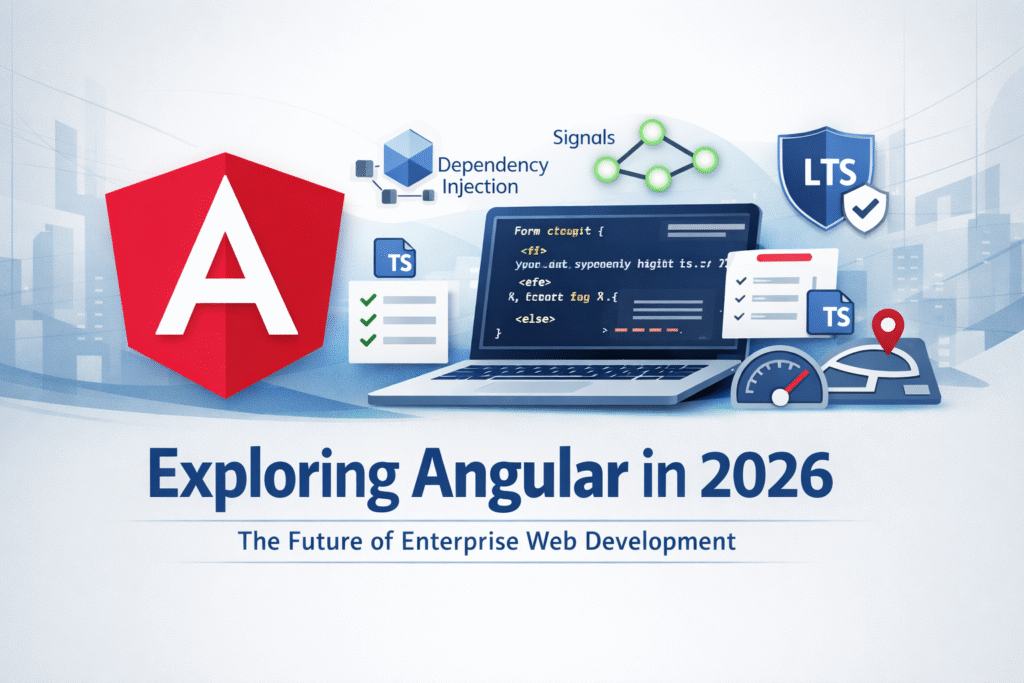
Angular is a comprehensive, TypeScript-based development platform maintained by Google. Unlike libraries that focus solely on the view layer, Angular is a full-fledged framework designed to provide everything a developer needs to build sophisticated Single Page Applications (SPAs).
Its popularity in 2026 stems from its opinionated nature. By enforcing a specific structure, Angular ensures that massive teams can work on the same codebase with consistency. This makes it the go-to choice for mission-critical industries like banking, healthcare, and government, where scalability and long-term maintainability are non-negotiable.
Key Features of Angular
Angular’s strength lies in its integrated features that work together seamlessly:
- Component-Based Architecture: Applications are built as a tree of modular, reusable components. Each component encapsulates its own HTML, CSS, and logic.
- Signals & Fine-Grained Reactivity: The latest versions of Angular utilize Signals, a reactive primitive that allows the framework to update only the specific part of the UI that changed, significantly boosting performance.
- Dependency Injection (DI): Angular has a built-in DI system that makes your code modular and easier to test. It allows you to “inject” services (like an API caller) into components without hardcoding them.
- TypeScript Support: Angular is built with TypeScript, offering strong static typing, advanced autocompletion, and early error detection during development.
- Built-in Routing and Forms: Whether you need complex nested routes or robust data validation in forms, Angular provides official, first-party modules for these tasks.
Practical Code-Level Examples
To understand how Angular works, let’s look at a basic component and the new control flow syntax introduced in recent versions.
Creating a Simple Component
A component consists of a TypeScript class and an HTML template.
user-profile.component.ts
Typescript
import { Component, signal } from ‘@angular/core’;
@Component({
selector: ‘app-user-profile’,
standalone: true,
templateUrl: ‘./user-profile.component.html’,
})
export class UserProfileComponent {
// Using the new Signals API for reactivity
userName = signal(‘Gemini User’);
isLoggedIn = signal(true);
toggleLogin() {
this.isLoggedIn.update(value => !value);
}
}
Modern Control Flow (The @if / @else Syntax)
The new syntax is faster and more readable than the older *ngIf directive.
user-profile.component.html
HTML
<div>
<h1>Welcome, {{ userName() }}</h1>
@if (isLoggedIn()) {
<p>You are currently logged in.</p>
<button (click)=”toggleLogin()”>Logout</button>
} @else {
<p>Please log in to see your profile.</p>
<button (click)=”toggleLogin()”>Login</button>
}
</div>
Key Points
- Enterprise-Ready: Designed specifically for large-scale applications with deep tooling support.
- Performance Optimized: Features like Zoneless change detection and Incremental Hydration make apps load and run faster than ever.
- Google-Backed Stability: Regular updates (every 6 months) and a strong Long-Term Support (LTS) policy provide peace of mind for business investments.
- Comprehensive Ecosystem: The Angular CLI (Command Line Interface) automates everything from project creation to deployment.
Conclusion
Developers choose Angular because it offers a complete ecosystem rather than a collection of fragmented libraries. While it has a steeper learning curve than its rivals, the payoff is a robust, secure, and highly predictable development experience. In 2026, with the move toward Signals and cleaner syntax, Angular has successfully combined the power of an enterprise framework with the speed and developer experience of a modern reactive library.
Get In Touch
"Share your ideas and get the best software service in the industry."

No comment